
Kraljević’s Paris
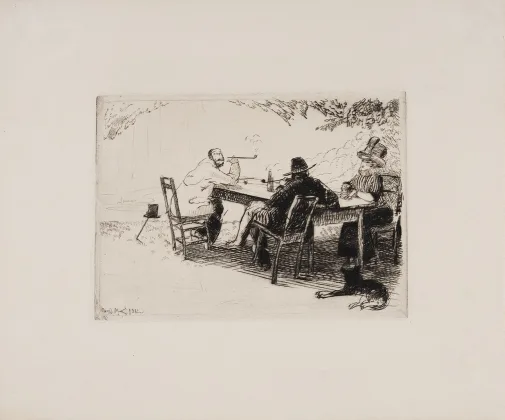
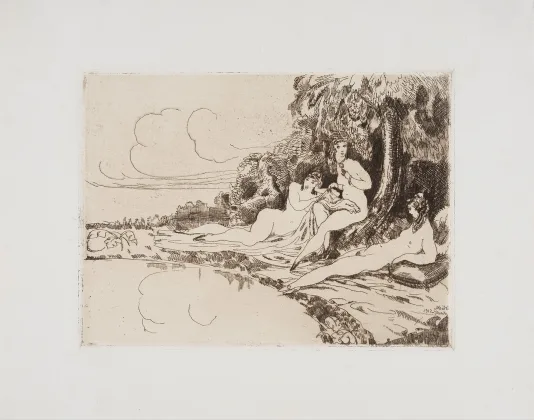
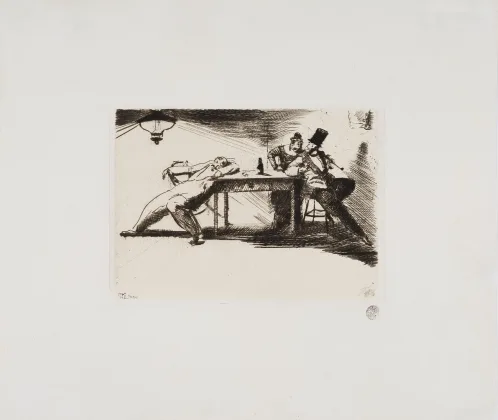
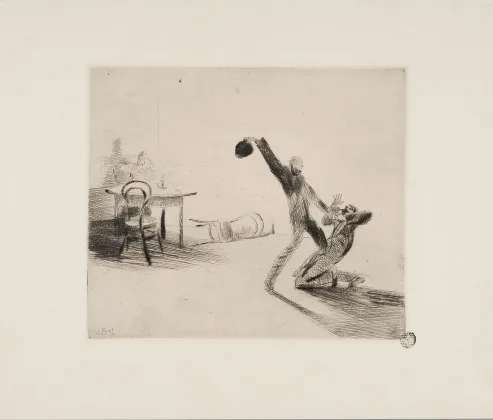
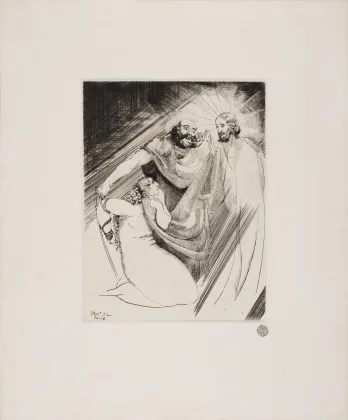
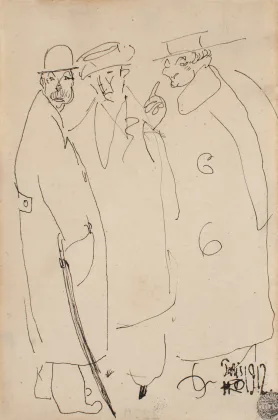
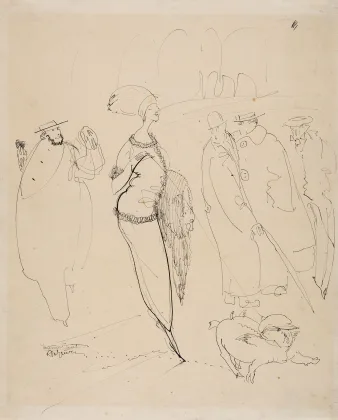
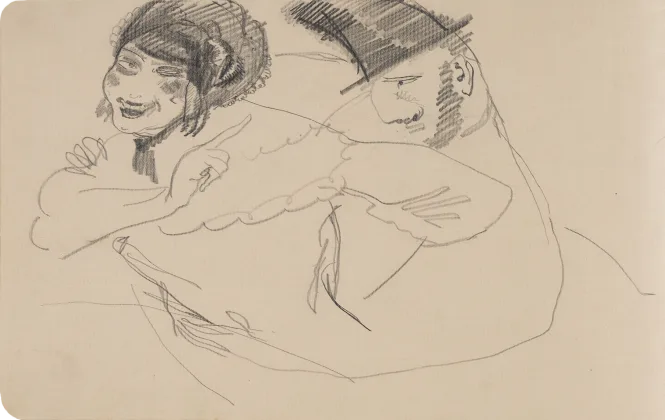
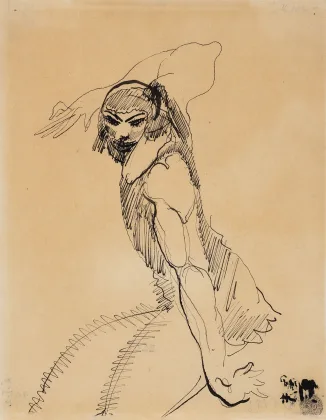
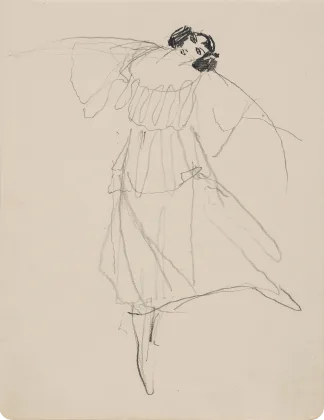
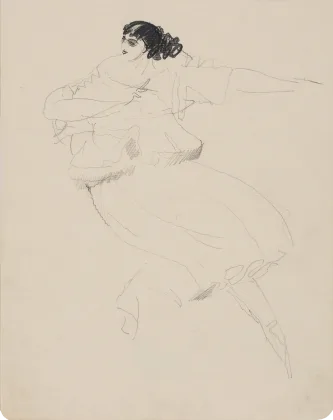
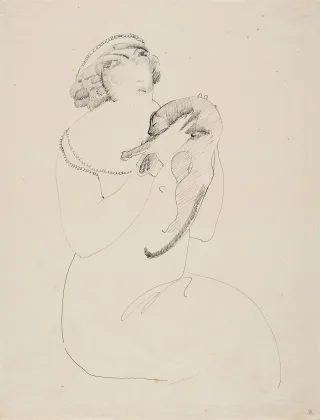
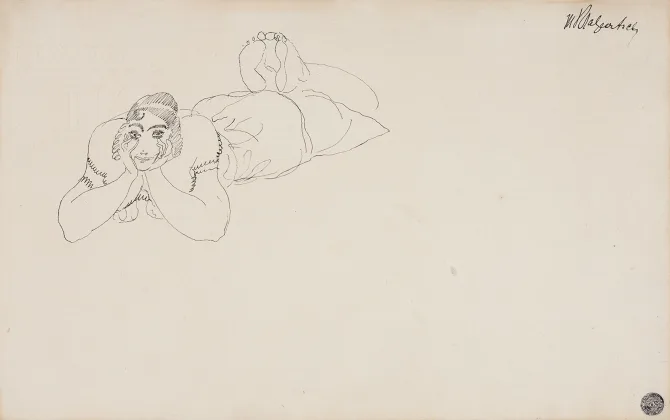
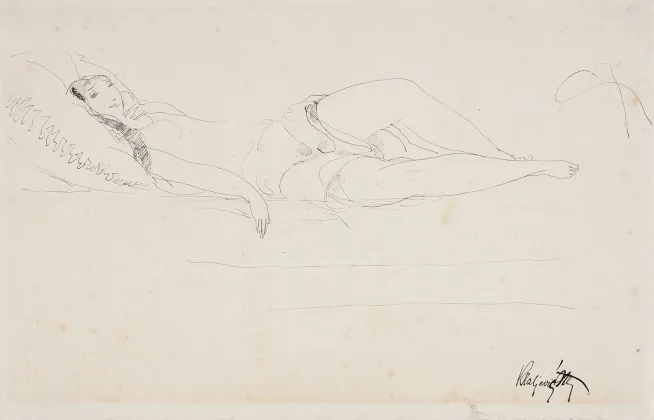
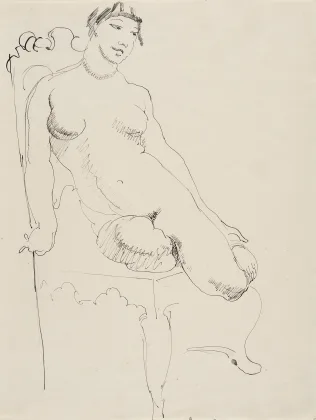
Among Kraljević’s drawing and printmaking work kept in the Department of Prints and Drawings, in a curatorial selection we are presenting his exceptional works made in the period between the end of his training on the Munich basis of realism, Art Nouveau and impressionism of Haberman’s class, to the Parisian period that saw the pinnacle of his painterly creativity in the wake of Manet and Cézanne. The presentational and interpretational point of view focused on his prevalently drawing efforts valorises and contextualises the development of the stylistic and morphological definitions of his signature syntax, detached from the hermeneutics of the Munich academism and leaning on the liberal manuscript of the upcoming stylistic pluralisms of the early 20th century.
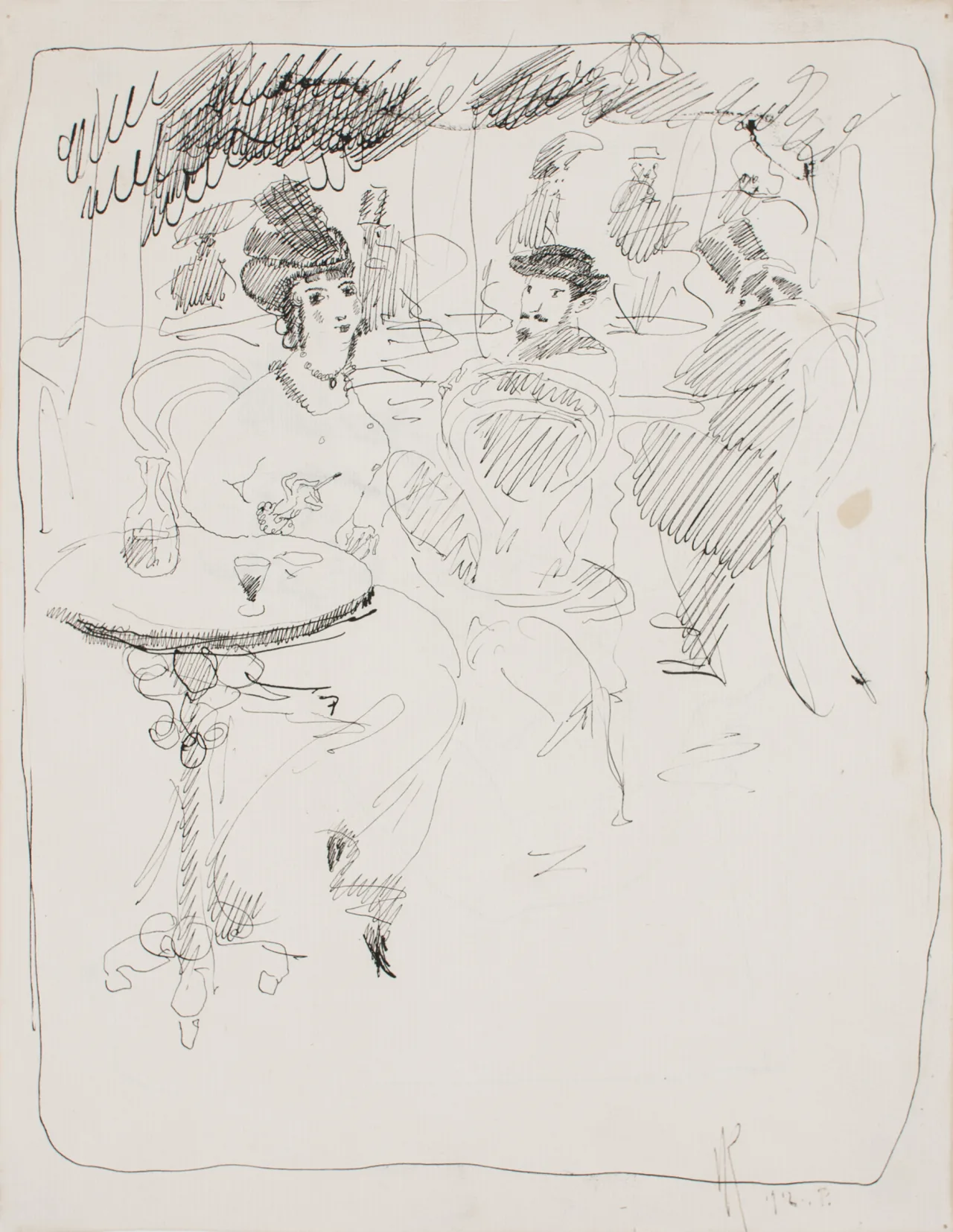
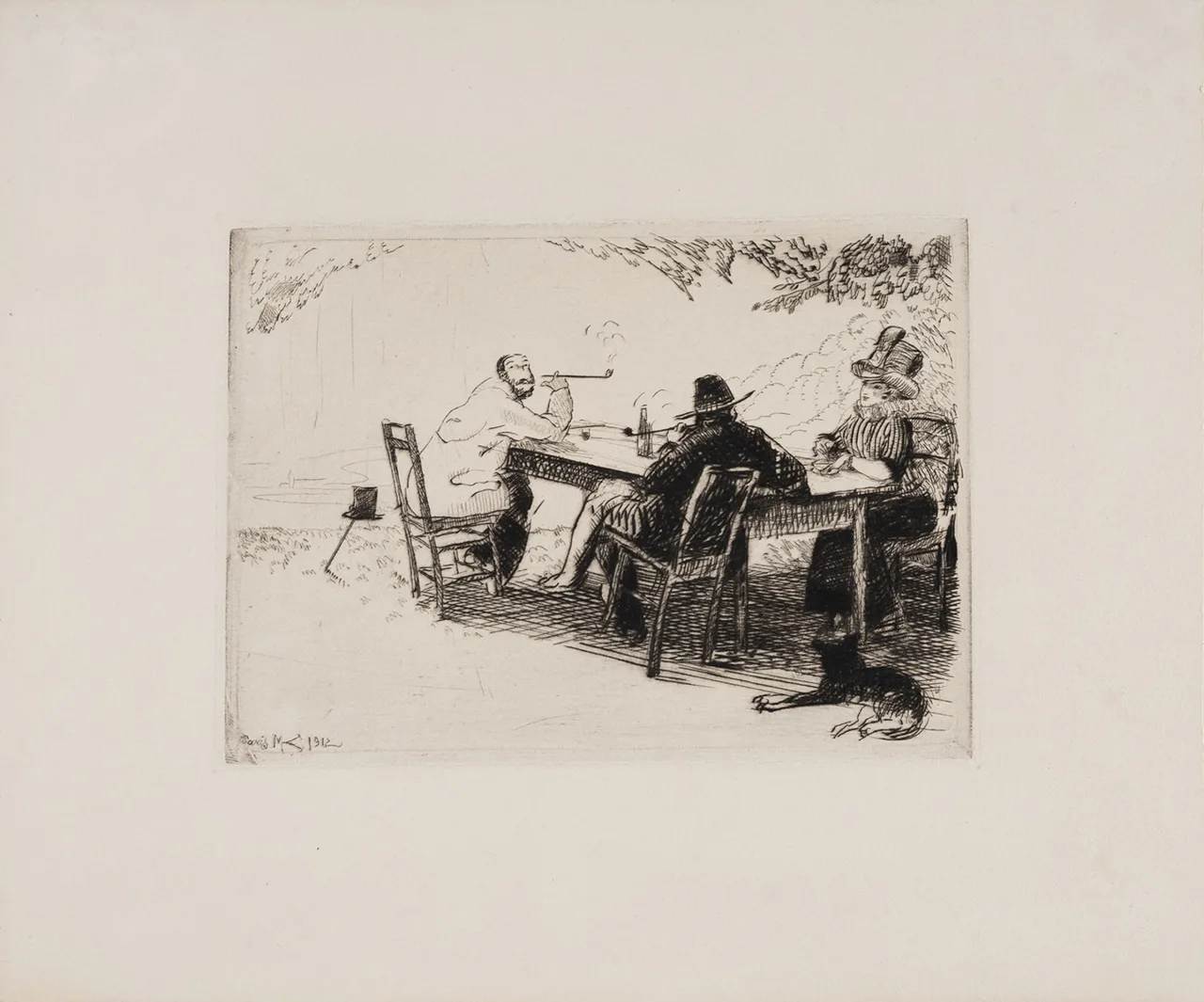
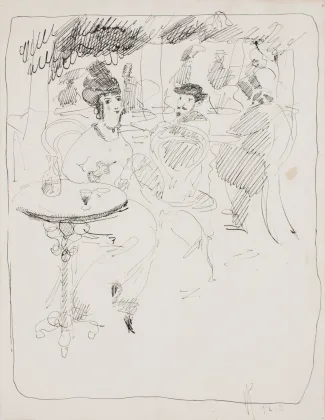
After the end of his studied in Munich in 1910 at the Academy of Fine Arts, Kraljević briefly returned to his family in Požega, where he stayed until September 1911, when he left for Académie de la Grande Chaumière in Paris, the capital of European culture, art and entertainment. His early days in Paris were marked, in addition to a lacking knowledge of French, by insecurity, loneliness and depression, as we learn from the letters he wrote to his family a few days after his arrival: “I am almost entirely exhausted… how could I not be, when everything I imagined as big in my head is five times bigger, everything I imagined as beautiful is five times more beautiful, and I wander around like a lost sheep, not even daring to admire this immense world, so rapid and hurried, with which I have decided to keep up. And despite this impression and not so pleasant depression, I sense that I might become accustomed here, to suck in all that is beautiful and good.” [2] Evading the shadows of tuberculosis which followed him to Paris, Kraljević began an intense period of his creativity – about to last until October 1912 – when he made hundreds of drawings and studies, a sort of journal of his Parisian life. The drawing In a Garden at a Café Table from the Department collection is probably one of the earliest from the Parisian period, judging by the signature and thematic context. From the chronological data and based on a comparison with the photographs from the period, Vera Horvat Pintarić in her monographic book on Kraljević concludes that the female character with a broad-brimmed hat at the café table is Hedviga Sternberg from Požega, and the man with the flat hat is Kraljević himself. [3] During his sojourn in Požega in 1911, the painter portrayed Hedviga, whom he fell in love with and to whom he subsequently “wrote long, tender and very romantic letters” from Paris. [4] Hedviga reminisced on this in her 1972 interview with Vlasta Kovač for Vjesnik: “He wrote about how he had been wandering and couldn’t find me anywhere. He wasn’t too happy in Paris. He felt very lonely.” [5] Assuming his mental state and the pain of faraway and unattainable love – because Hedviga’s parents wouldn’t let her marry an artist – on the man’s face we discern disbelief and/or surprise over finding the desired subject. His quill stroke is rapid, nervous, impatient, intuitive – akin to his experience of the big city – fragmented into a cluster of dense linear fillings and interweavings, switching, succinctly and jumpingly, from geometrical to undulating, almost unfinished parts of the outdoor space, giving the drawing a vibrant, dynamic rhythm. The patience of the stroke is visible only in the painstaking elaboration of the portrait traits of the protagonists (and their hats), particularly in the subtle loveliness of Hedviga’s face (as in the print Day Trip). [6]
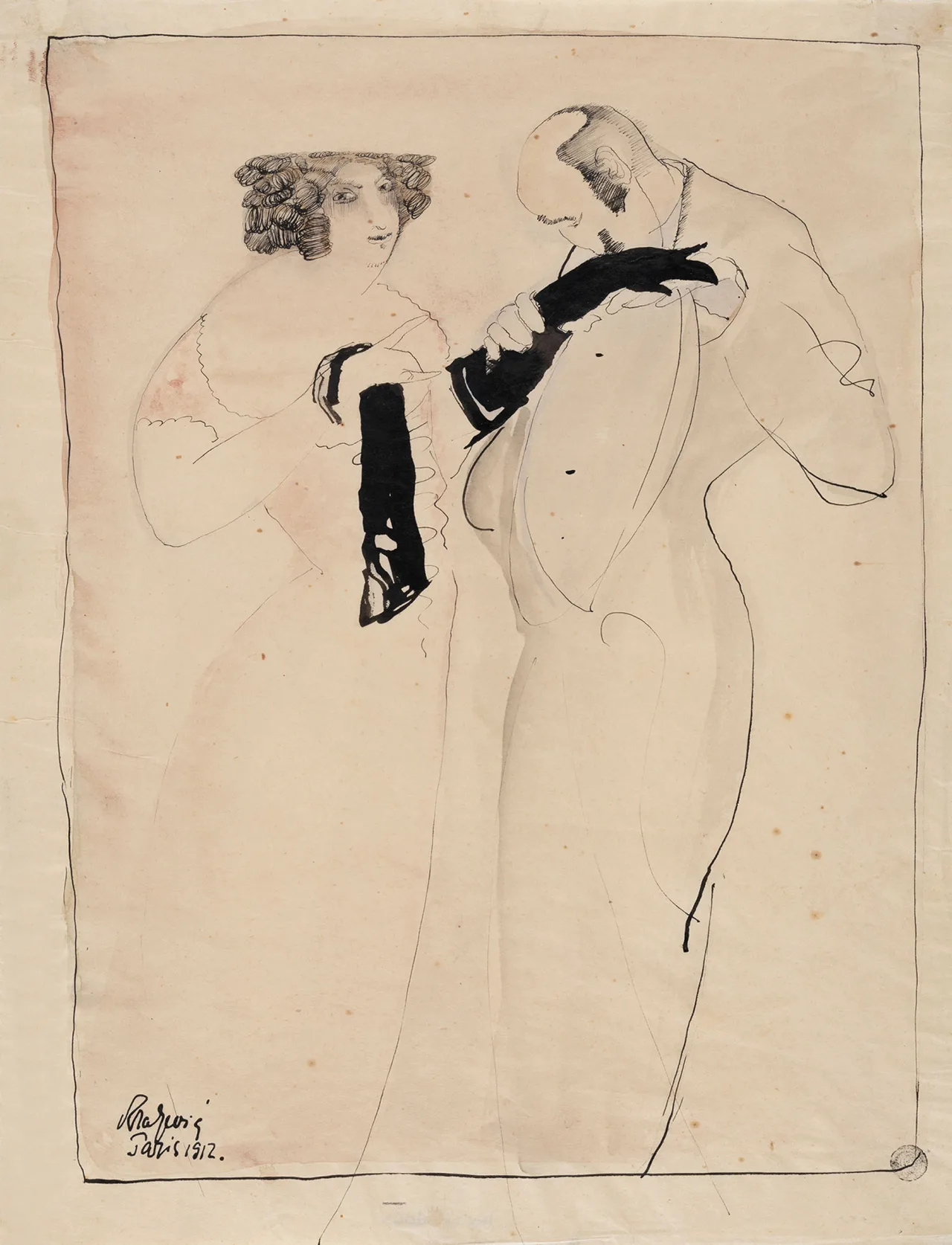
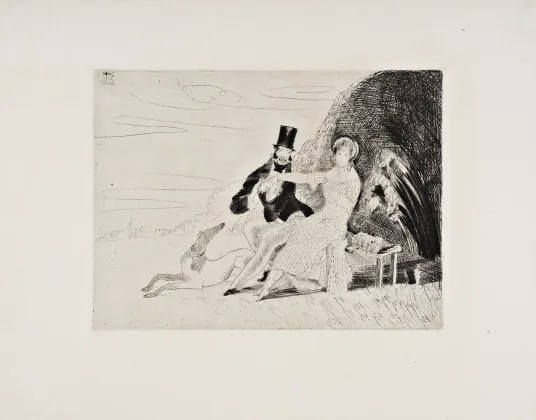
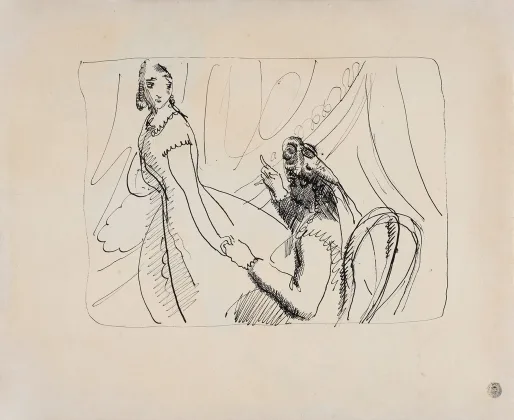
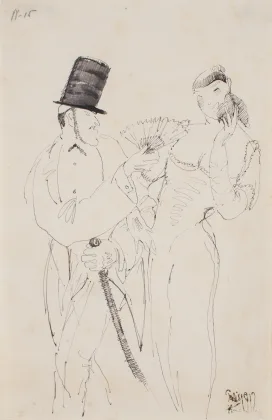
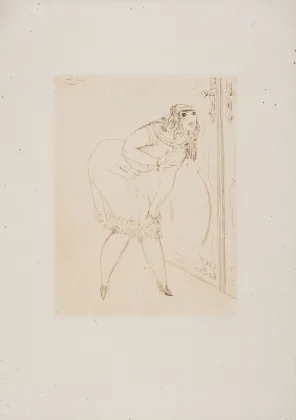
As a shrewd and astute observer of the Parisian bohemian and mundane lifestyle, Miroslav Kraljević in his many drawings dating from 1912 gives a poignant and ironic comment on the characters and atmosphere of the wanton and frivolous Paris, just like Gamulin concludes: “None of our painters had penetrated the Parisian days and nights so closely and in such a short time.” [7] This drawing chronicle of the bourgeois milieu also includes the scene Courting, in which Kraljević’s sharp quill captures the atmosphere of the encounter and the tension in the characters’ posture; the woman’s distance and a slight ill-mood on her face, compared to the man’s enthusiasm visible in the rapture of holding and kissing her hand. The reduced outline is light and gentle, occasionally lost or slightly curvy in defining the edges of the lady’s dress, and only stronger and more forcefully imprinted through the artist’s quill trace in defining the outline of the man’s suit. With several skilfully drawn lines, he defines the facial expressions and gazes, and manages not only to nuance the characters’ state of mind and mood, but also comment on the situation, to hint at the narrative. The motif, the caricatural and ironic note and the morphological similarity with the series of works Kraljević made for the exclusive Panurge serial as a commissioned illustrator point to a possibility that the drawing (framed with a border line) might be one of the many he made for the serial. Vera Horvat Pintarić wrote about it in her monographic book on Kraljević, with a suitable quote: “A separate section is intended to the ‘Life of gracious men’, describing the types of lovers; ‘lover of the heart’, gigolo, procurer and parvenu; instructions are given how to become a dandy and what are the skills Paris demands from those coming there: a lie serving both attack and defence, however ‘one must lie with a lot of sincerity, hypocrisy and nonchalance’, because ‘once you fall in love, you are lost’; therefore one must ‘feign love and indifference’, because ‘idealism is the enemy of youth’; fine hats are recommended, as well as manicured fingernails and perfumed body because ‘a real charmer must differ from others with nothing or with exaggerations (par des riens oû des énormnités), and gallantry towards women should be pushed to extravagance’.” [8] Black gloves in soft velour are the strongest accent of the drawing and evoke reminiscences of Toulouse-Lautrec’s versions with almost identical position of the woman’s fingers. The gloves are in fact identical to those worn in the 1890s in Toulouse-Lautrec’s drawings of Yvette Guilbert (1865-1944), a French Belle Èpoque cabaret dancer and actress. [9] Nocturnal scenes in cafés, taverns, variety theatres, concerts… the virtuosity of a dynamic and free line, accentuated black and white parts, and especially the outstanding capability of the characters’ psycho-description are the links pointing to identifying the correlations with one of the greatest painters and draughtsmen of the French post-impressionism and Art Nouveau illustrators. Despite these correlations, Kraljević’s quick and nervous stroke, the manner of reducing the subject, the cheerful note of irony (in contrast to Toulouse-Lautrec’s ‘bitterness’) in handling the theme and the mastery in structuring the composition rightfully elevate him beyond his direct or indirect influences during his stay in the capital of the arts, confirming his incontestable drawing gift and independent artistic idiom.
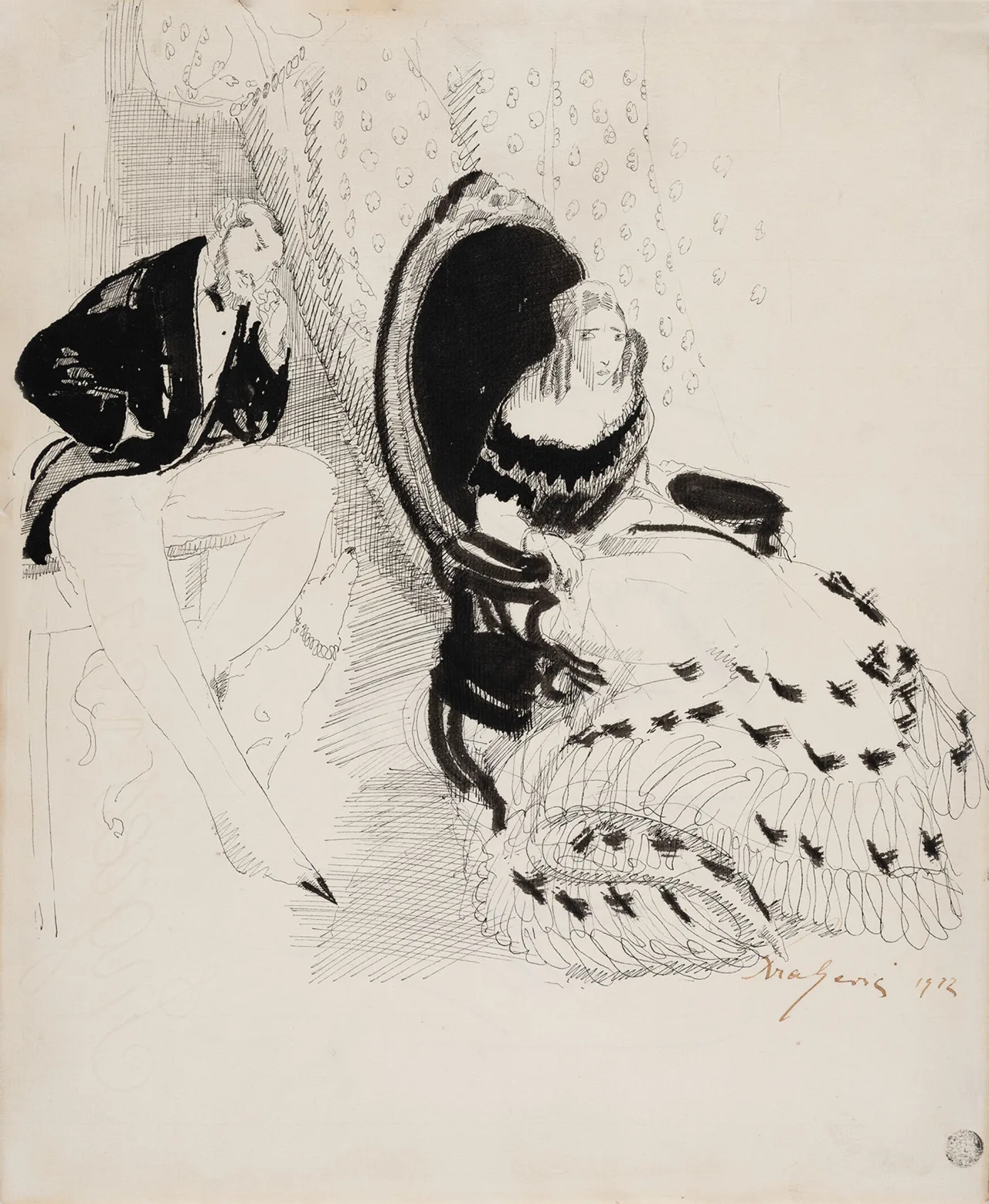
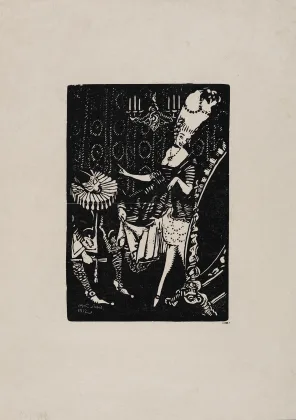
Knowing the artist’s penchant for literature, critic Artur Schneider mentioned literary sources and gave guidelines for the reading the literary models Kraljević turned into drawings, among which the motif of the drawing Question was taken from Balzac’s novel Lost Illusions (Ilusions perdues, 1836, 1837). [10] Re-enacting the scene of a conversation between madam Louise de Bargeton and young poet Lucien de Rubempré, Kraljević conveys the atmosphere and the fashion of the Parisian salons of Balzac’s era. In the depictions of the female salon outfits Schneider recognises the influence and manner of Baudelaire’s modern life painter Constantin Guys (1802-1892) and his “monumental style of drawing cocottes” in “frilly enormous crinolines”, with “long curly hair strands…”. [11] Despite the constructive synthesis of Balzac’s novelist subject and Guys’s mundane style of the Second Empire, Kraljević’s drawing idiom surpasses the literary and painterly boundaries. We identify it in minute grid filling of the background, braced curtain patterns, soft and wavy creases of the dress and its smudgy patterns, in the opposition between black and white parts, and according to Vera Horvat Pintarić – in the type of the charming woman’s face with raised eyebrows, in poet Lucien’s face with Kraljević’s features and in the character of the dog which doesn’t exist in the novel. [12] The artist skilfully interprets the states of mind and the dilemmas of Balzac’s characters, drawing the handsome poet Lucien as relaxed, with a casually outstretched right leg, confident in posture standing next to madam de Bargeton, who represents Balzac’s type of upper class women. Kraljević magnificently demonstrates his skill of psycho-description, drawing the moment of utmost suspense when two former lovers briefly evoke the illusions from their common lovers’ past. [13] In Kraljević’s brilliant execution, these two Balzac’s heroes become the prototype of the French blasé and decadent society, and an ironic and universal critique of his peers in the interpretative context.
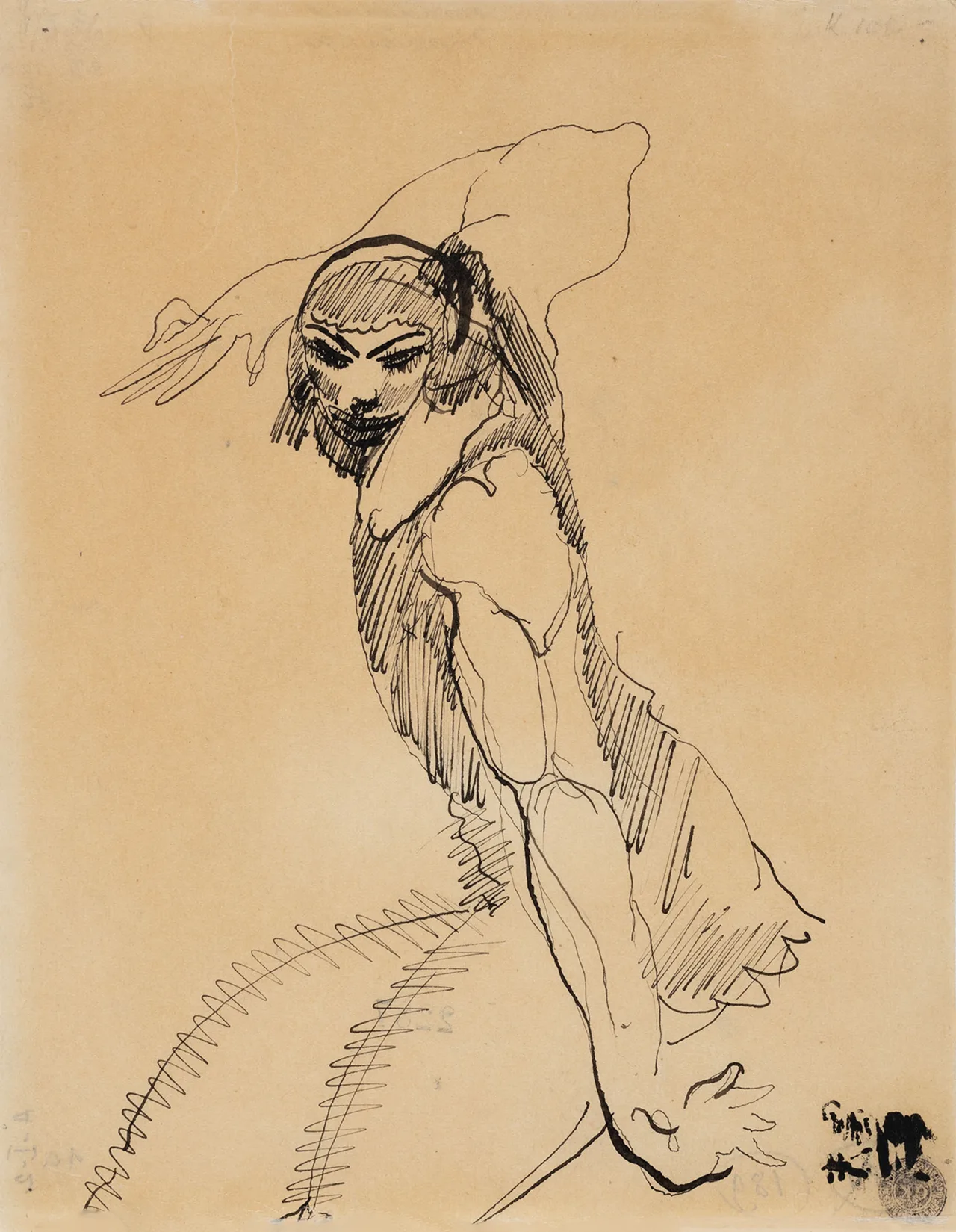
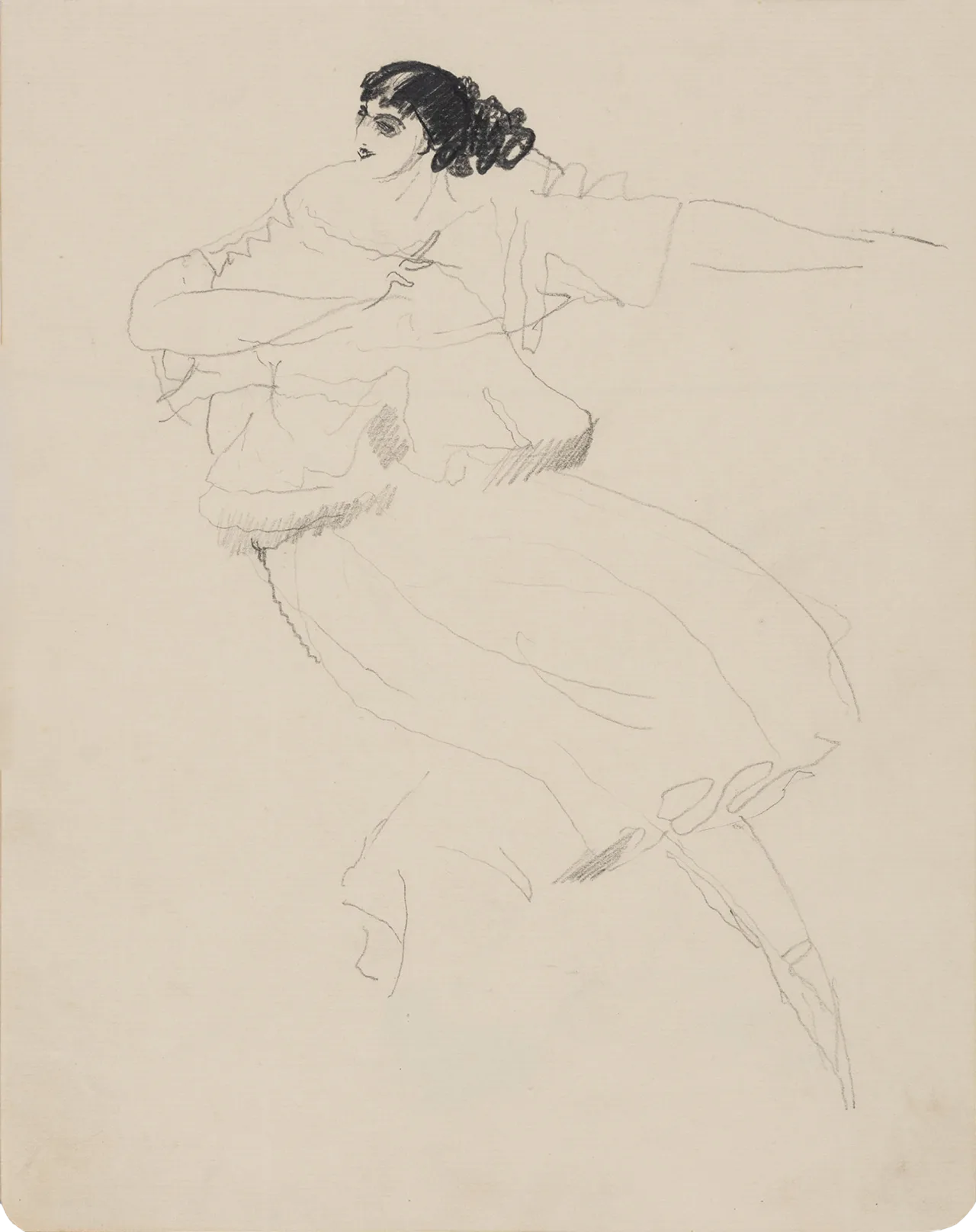
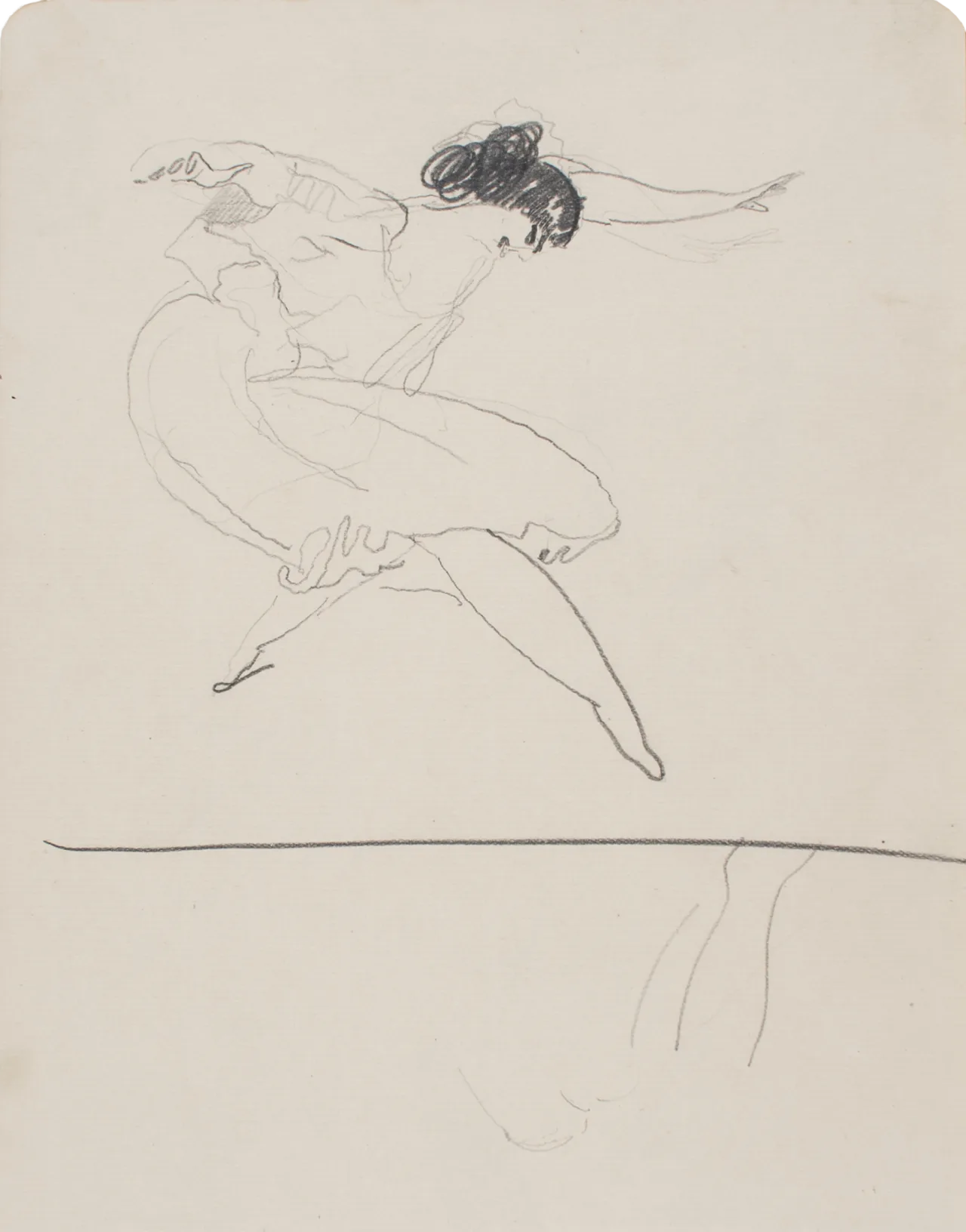
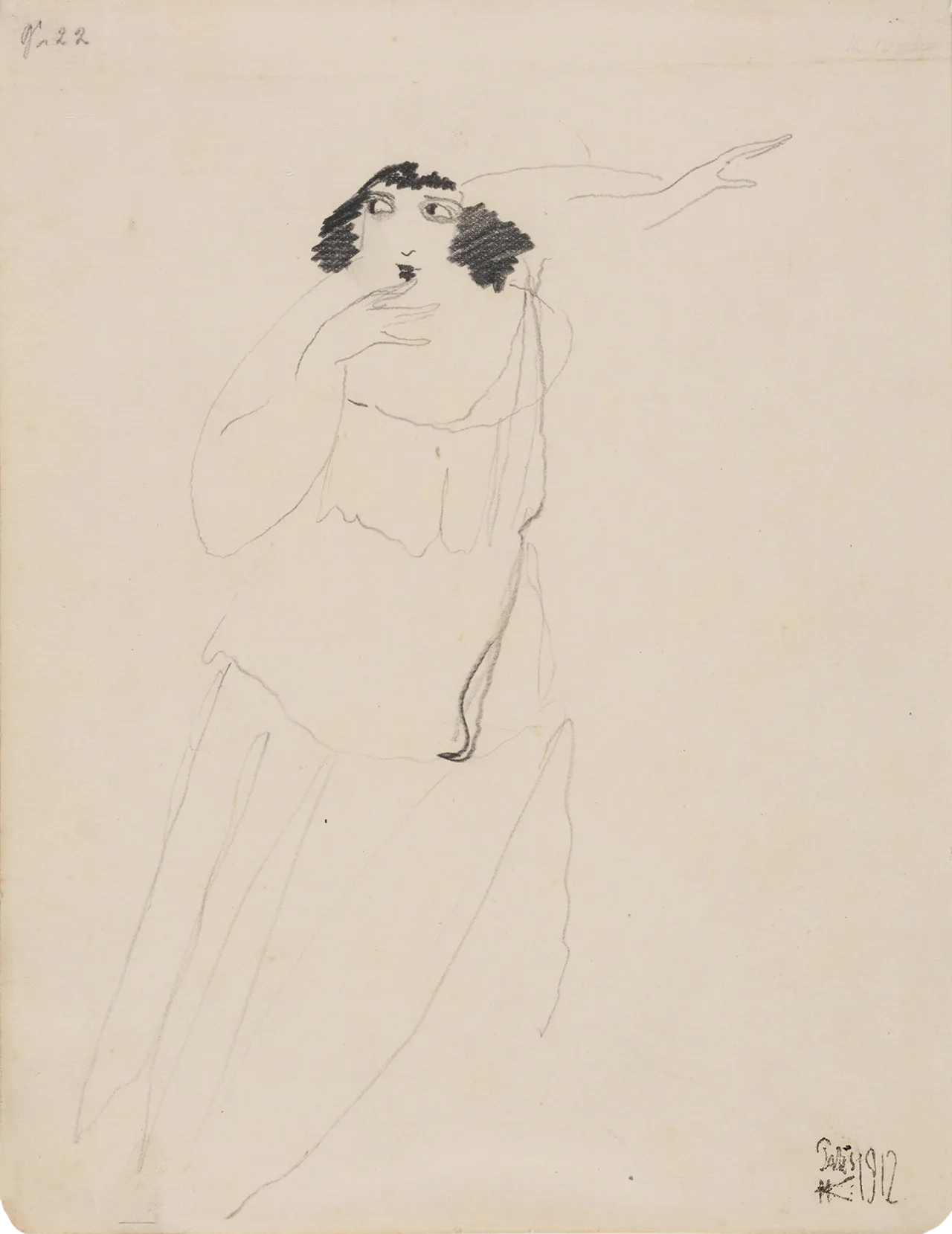
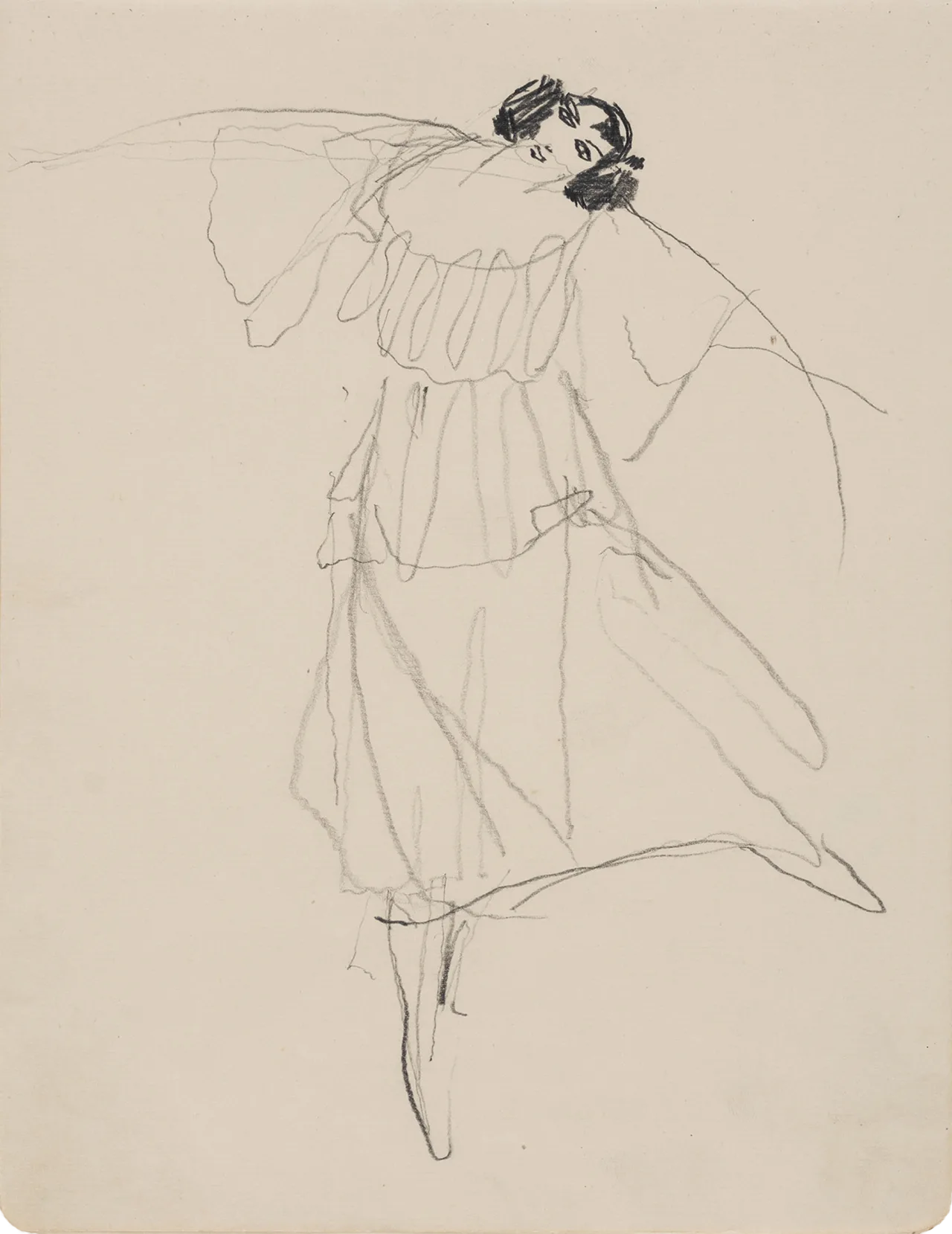
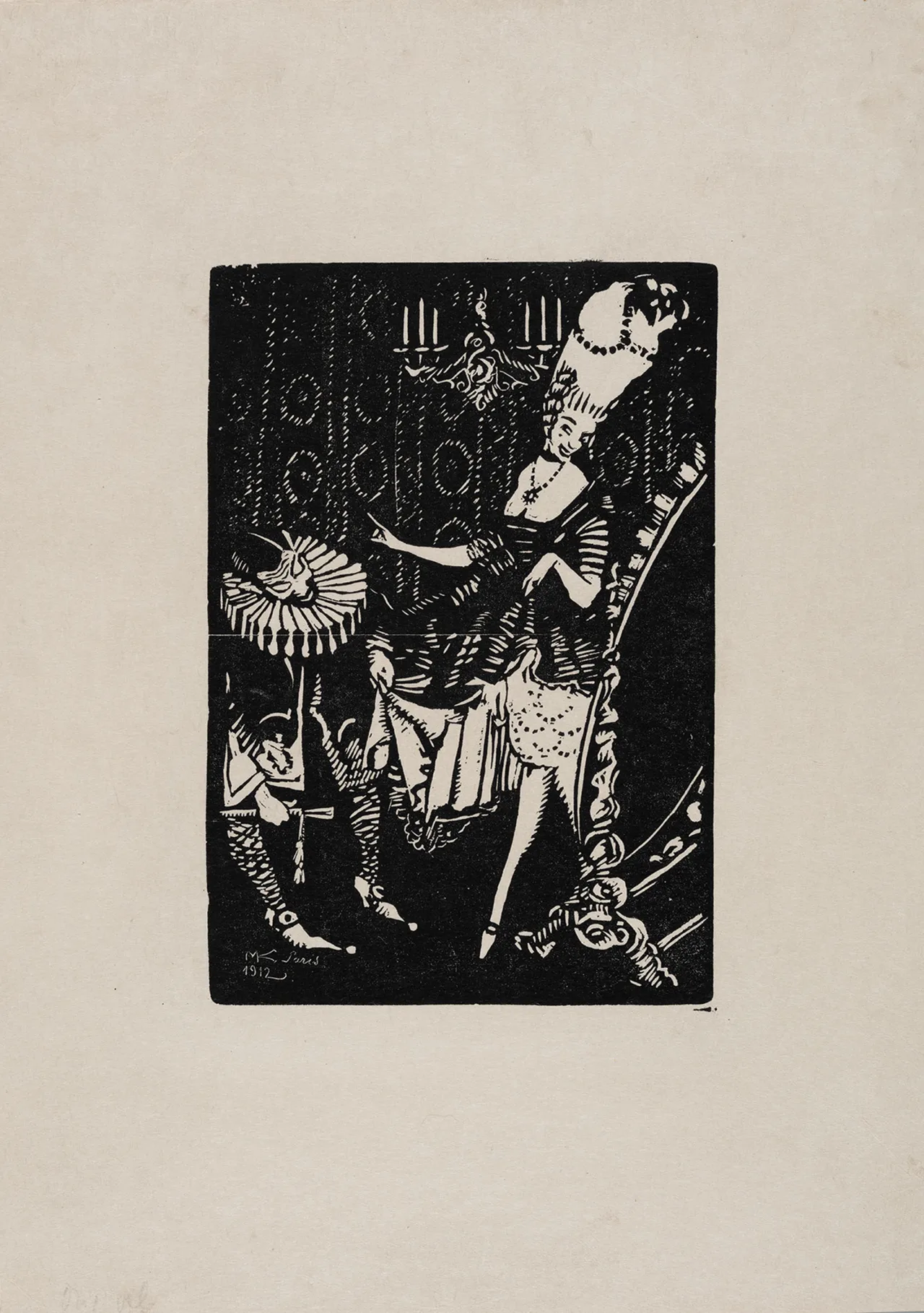
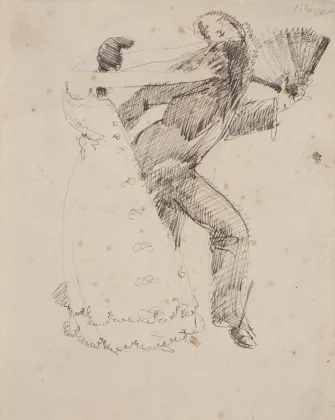
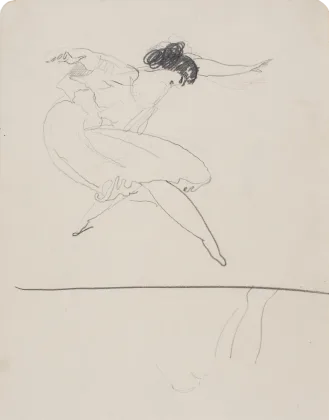
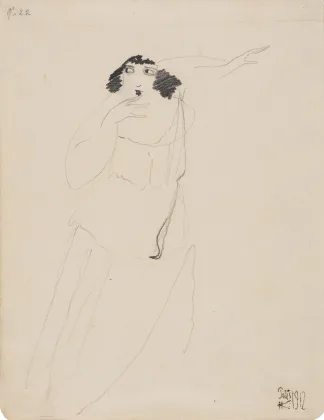
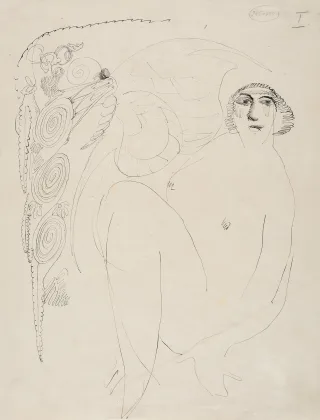
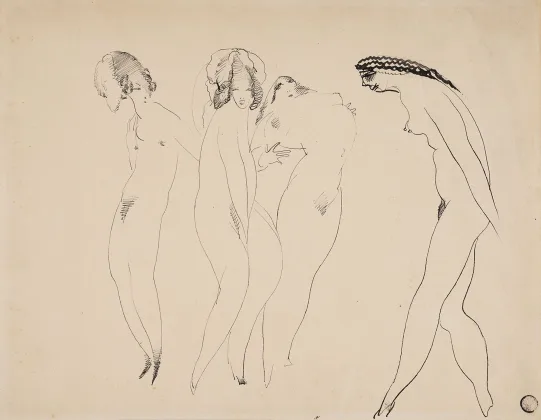
Young Miroslav Kraljević also found his inspiration in the artistic atmosphere of the early 20 th century avant-garde Paris. Sergei Pavlovich Diaghilev’s Ballets Russes enthralled the Parisian and European audiences since 1909 with their ingenious, fresh and modern set designs and choreographies. [14] Unable to make his vision of shifting the boundaries of music tradition come true in Petrograd, because of the rigid local audience raised on the academic principles of Petrograd’s imperial ballet, Diaghilev founded the Ballets Russes company and made unparalleled success in Paris and Europe. With outstanding stagings by Michel Fokine and set design by Léon Bakst, with the genius compositions by Igor Stravinsky and Claude Debussy, and the masterful performances by the god of dance Vaslav Fomich Nijinsky and the leading ballet dancer Tamara Karsavina, Ballets Russes hosted complex visual and music productions at Paris’s Théâtre Mogador and Théâtre du Châtelet, blending all art forms – music, dance, choreography – into extravagant performances which revolutionised the world of music. [15] Inspired by the costumes and the magic and harmony of virtuoso ballet movements, Kraljević’s drawings of Weber-Berlioz’s Spectre de la Rose (Dancer in Motion / Vaslav Fomich Nijinsky) and Schumann’s Carnaval are some of the finest drawings of Ballets Russes, underlining his fascination with the character and movements of the dance genius of Nijinsky and the loveliness and tenderness of Karsavina. The collection of the Department of Prints and Drawings keeps Kraljević’s drawing notepads with sketches and studies – mostly nudes and female characters – made in the places he frequented in Paris. One of them contains several sketches where he, with utmost precision, portrayed the alterations of movements, jumps and poses of the ballet dancers (Dancer in Motion I, Dancer in Motion II, Dancer in Motion III). The drawing Ballet Dancer (of Tamara Karsavina) was most probably made at one of the performances of Ballets Russes. Based on research of the iconography of figures according to their descriptions and photographs, Vera Horvat Pintarić says of the drawing: “… the Dancer in a soft long dress, deeply curved high in the upper part and elongated, like a tunic, a dress similar to Bakst’s for Debussy’s Prelude to the Afternoon of a Faun, choreographed by Nijinsky, who resorted to the figures from the Grecian urn paintings for the dance steps – just like Bakst for the dresses.” The premiere of The Afternoon of a Faun took place on 29 May 1912, so it is possible that Kraljević might have attended it or visited some of the future performances, held at Théâtre du Châtelet. [16] In a manner of a virtuoso draughtsman, with a sketchbook on his knees and a pencil in his hand, he captured the leaping pirouettes and sensual poses of the ballet dancer, bequeathing us a valuable record for a reconstruction of the choreographic elements of a production which became a huge success, but also remained as controversial, charged with powerful emotions and imbued with over-erotic allusions and evocations.
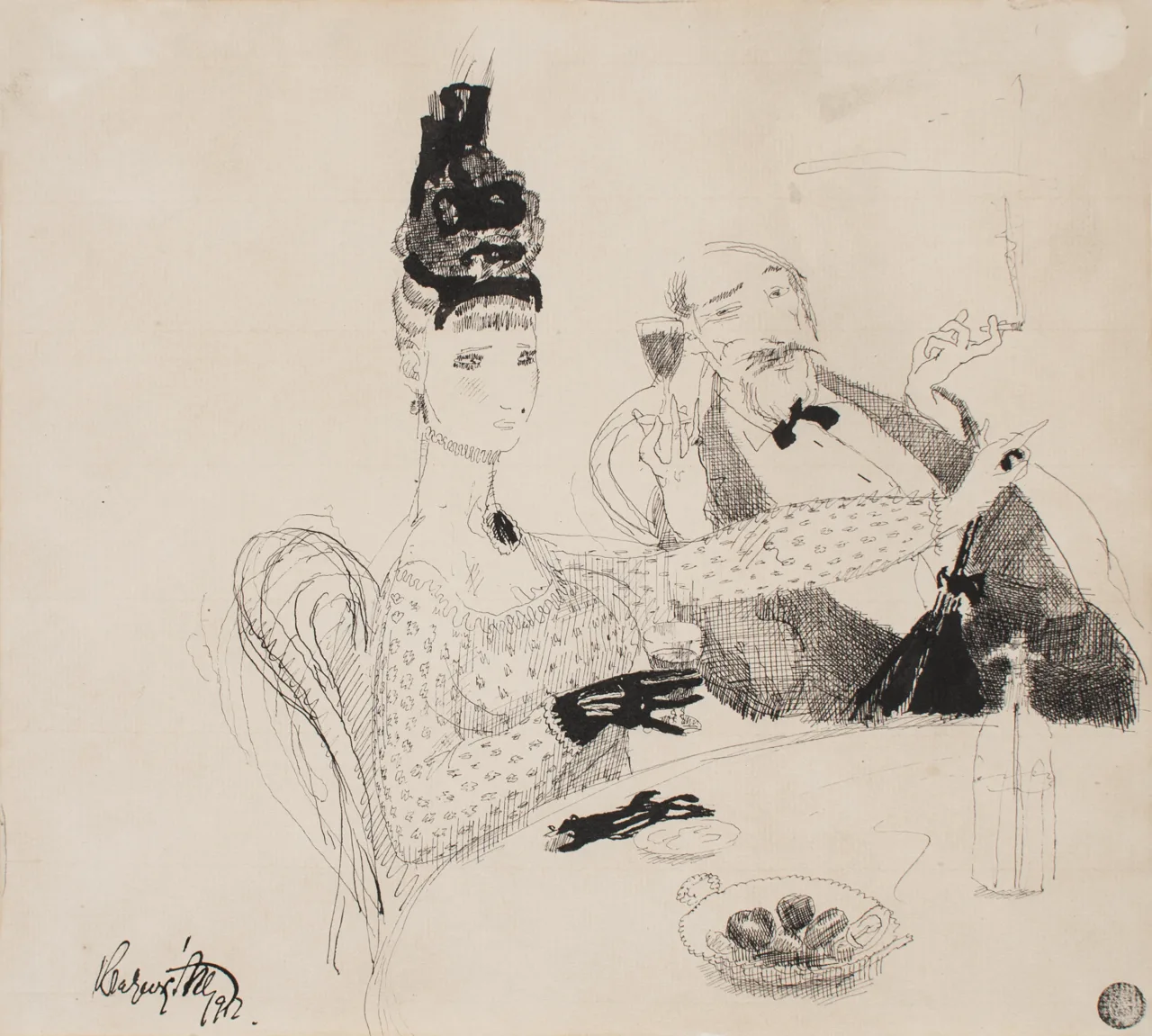
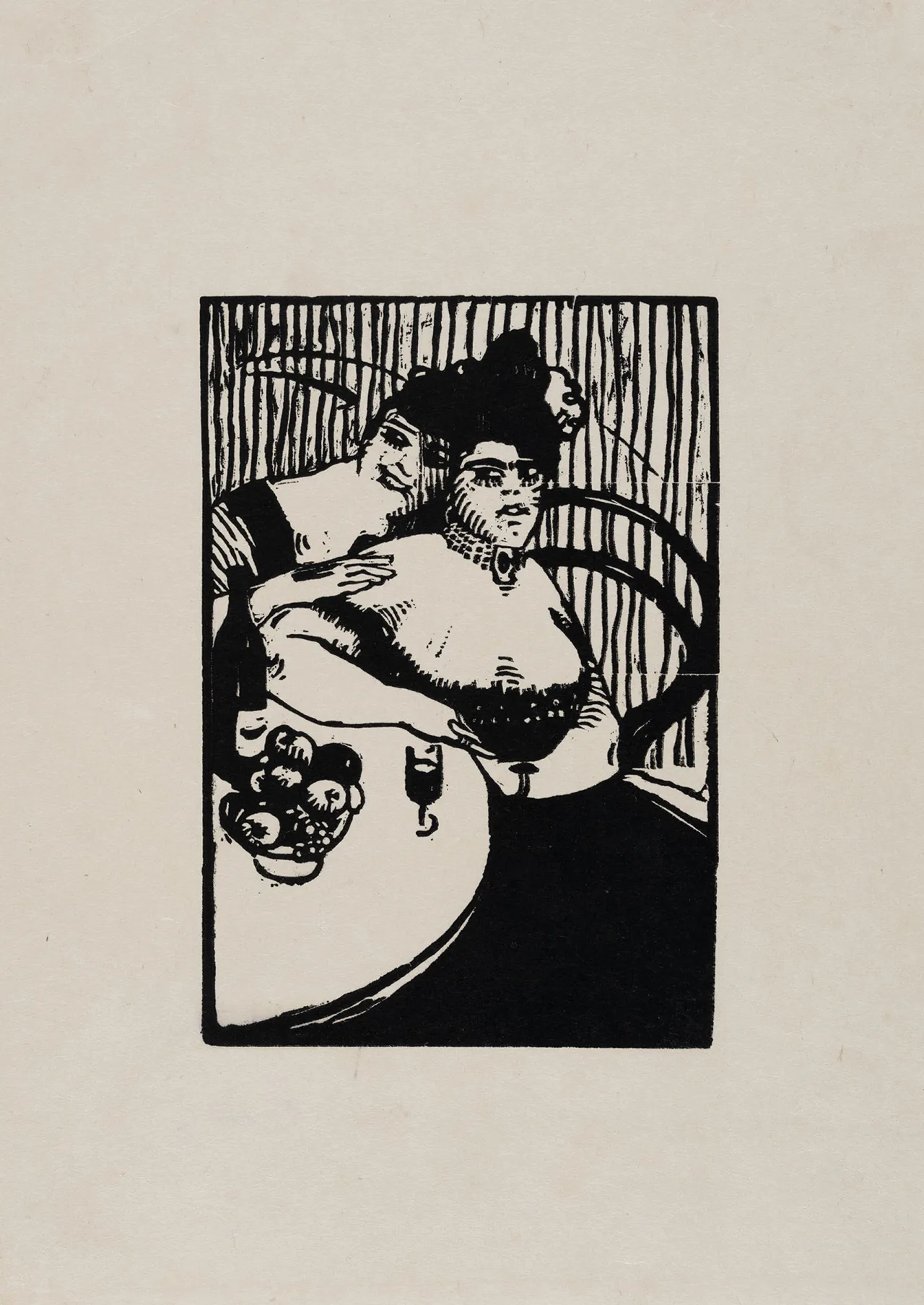
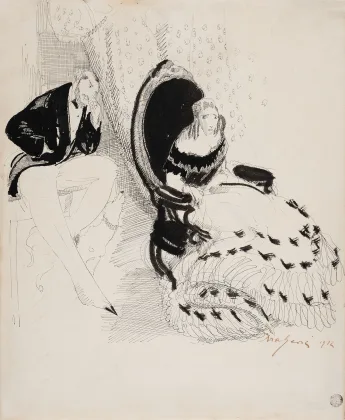
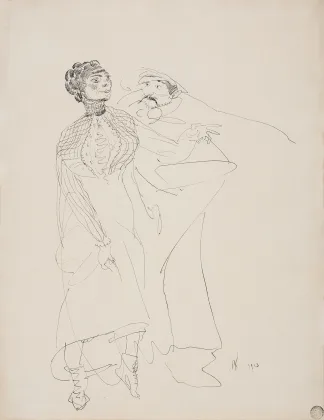
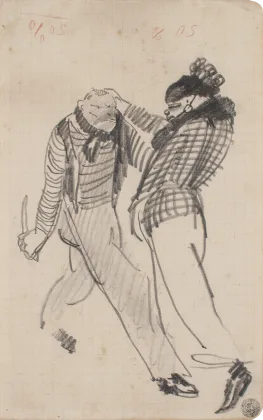
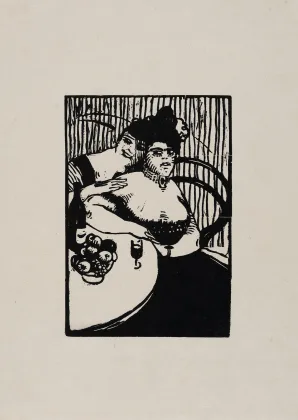
Delving deeper into the frenzied and hysterical ruckus of the modern and blasé Paris, Kraljević frequented cafés, taverns, nigh bars, brothels… noisy and dim interiors smelling of wine and suffocating in smoke, in search of motifs and themes. Despite his illness, he led the bustling life of a bon vivant, painting by day and wandering by night to document all these picturesque places of the wayward and decadent Paris in his drawings. There was no shortage of themes and motifs, he found them every step of the way, because he went to cheap places meant for entertainment and pleasures: Bal Bullier, Moulin de la Galette, Tabarin, Moulin Rouge, cafés and taverns: Taverne Dumesnil, Café du Dôme, Taverne de la Rotonde, Bar Olympia… [17] In the work Woman and Man at Table, Kraljević drew the atmosphere of everyday life at the café, a segment of one of the countless stories he witnessed, that was his sarcastic critique of Parisian bourgeoisie, and as Artur Schneider ironically concludes: “However, this bourgeois note appears rarely in the drawings, almost regularly only in freer situations, when a benevolent old goat, as it often happens, strays off course.” [18] Kraljević-draughtsman is a shrewd and subtle portraitist of the lady’s somewhat absent and dismal look and the elderly gentleman’s rowdy expression, and a skilful documentarian of the conversational scene accompanied by their wine-drinking lively gestures. [19] The morphological similarity to the typology of women and the 19 th century fashion in Constantin Guys’s drawings is evident from the character of the woman “sitting with a man at a table, with a long neck, hair pulled up high and a necklace under her head, with a locket on her chest, similar to Guys’s”; [20] the typology reinterpreted by Kraljević in the early 20 th century in his own drawings – creating in the process his own fashion ‘iconography’. Interestingly, V. Horvat Pintarić interprets “corny female hands with a lifted forefinger and little finger” as witchcraft symbolism. [21] Kraljević dedicated wondrous patience to pencilling out the floral motifs of the lady’s dress, and filling the old dandy’s suit with a line grid all the way to the parts where they smudge into a blot. The ink blot accentuated the lady’s hair, the locket and the gloves, as well as the man’s bow tie. As though he exhausted himself in drawing these outfit details, he drew the outlines of the furniture casually and rapidly, with a careless set of lines, completely neglecting, i.e. abstracting the interior of the café scene.
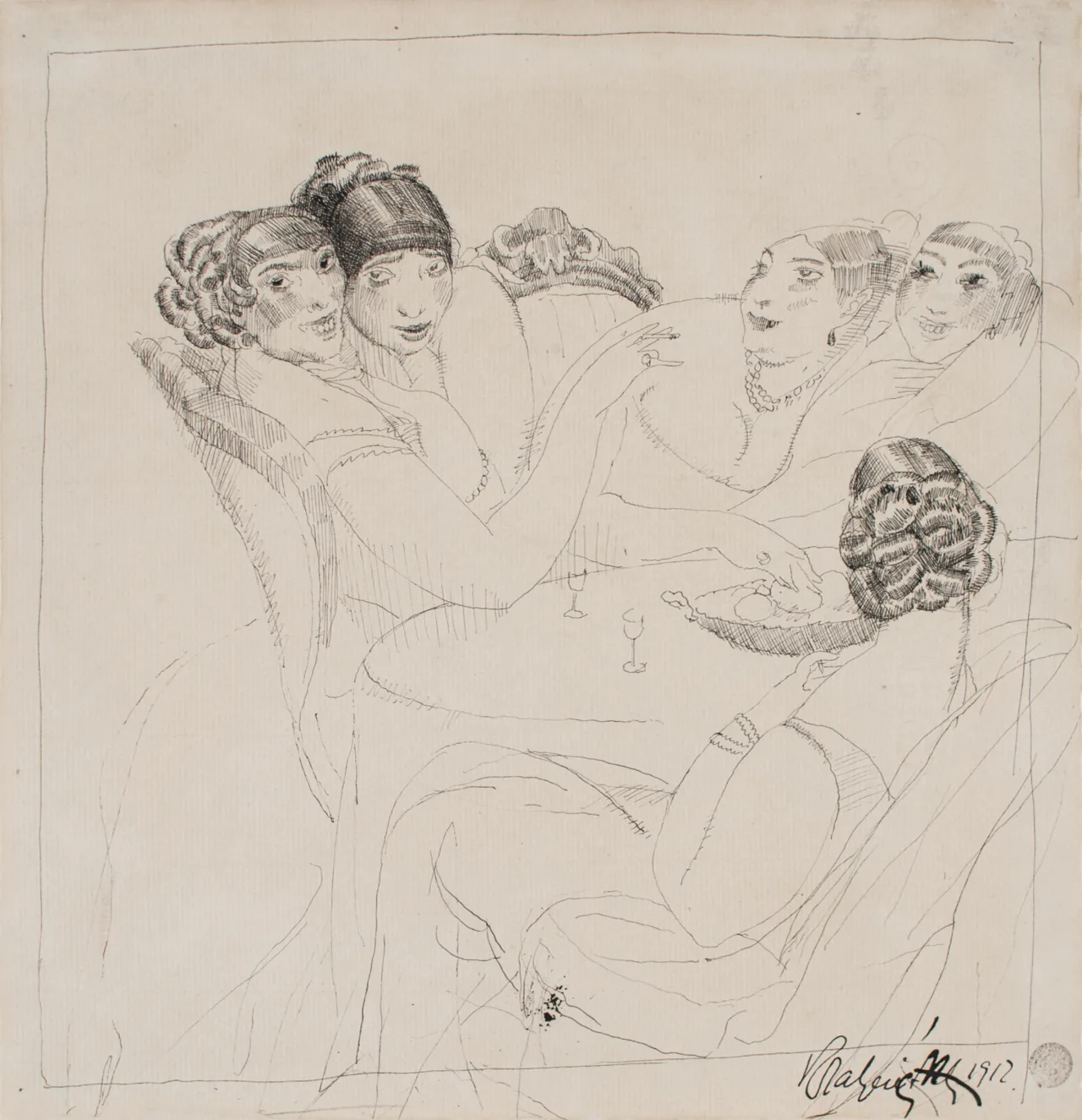
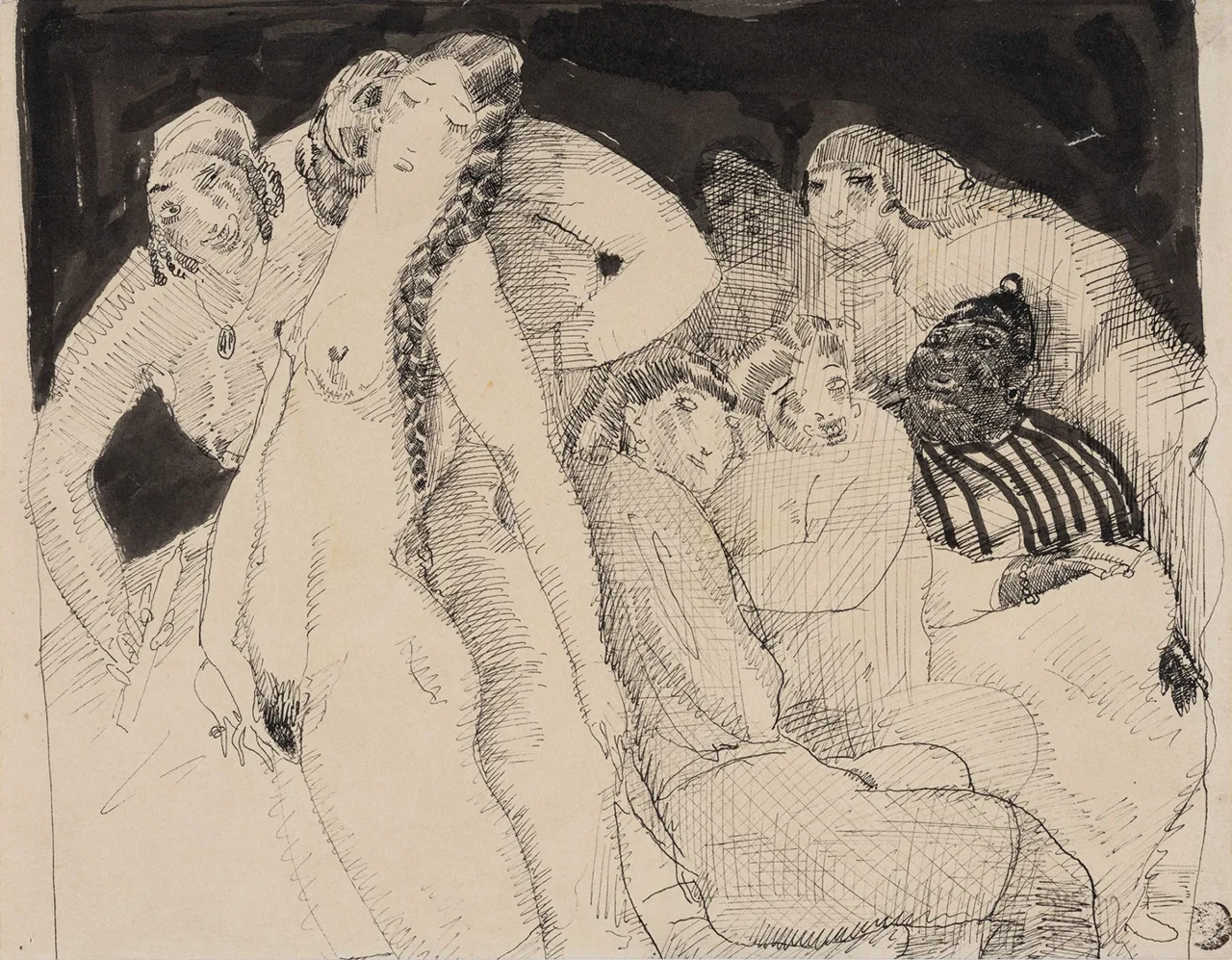
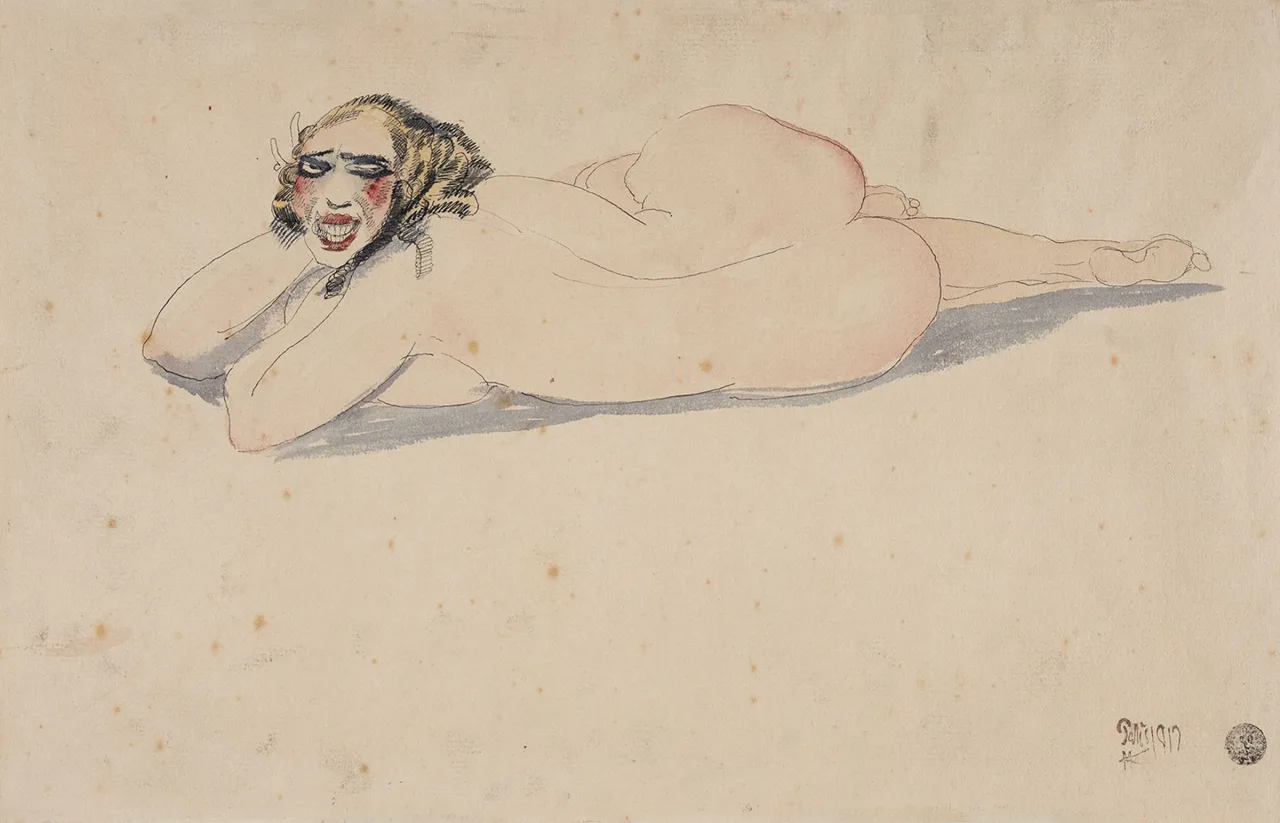
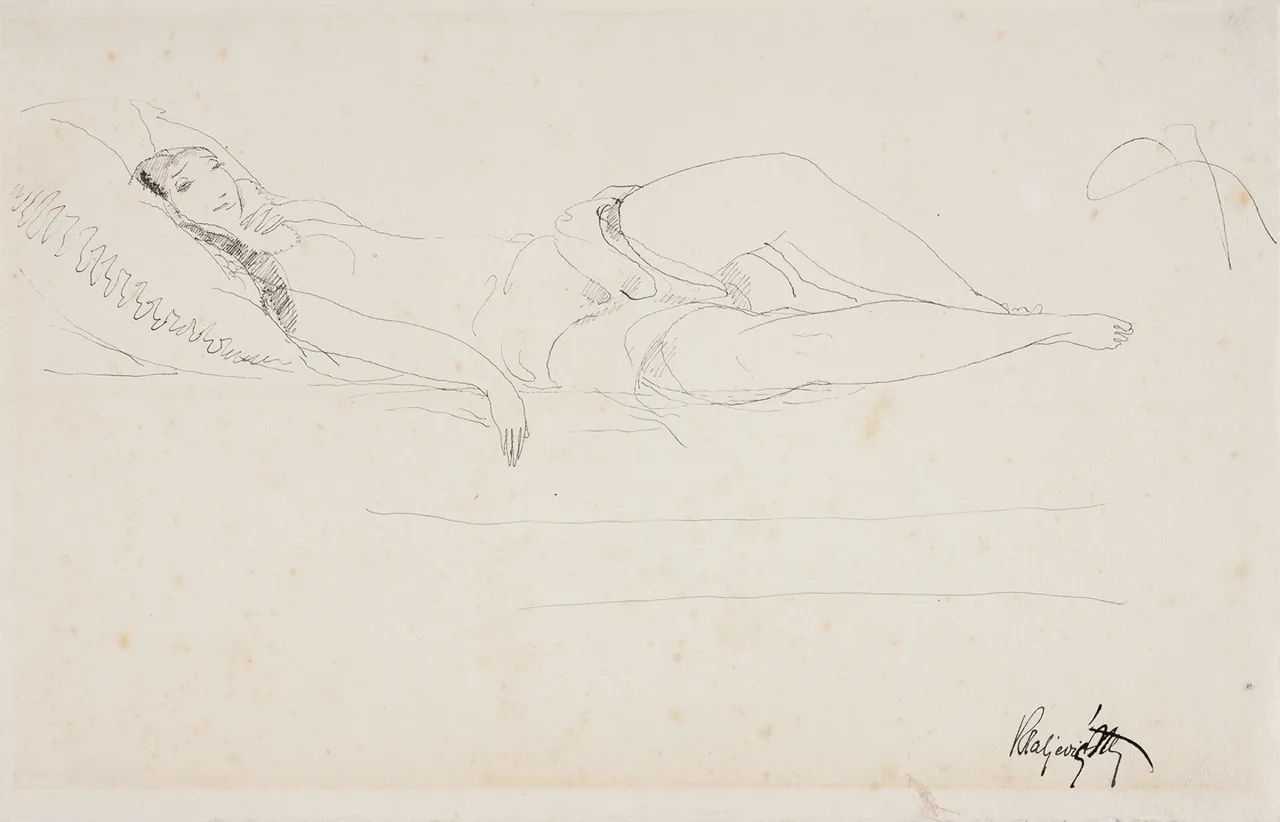
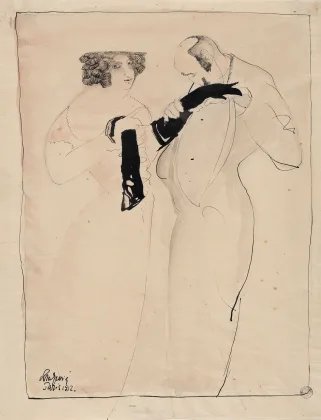
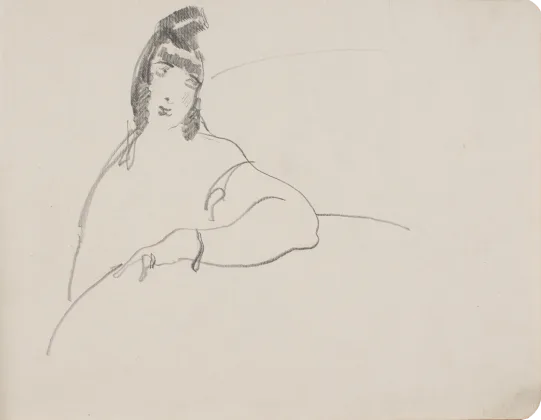
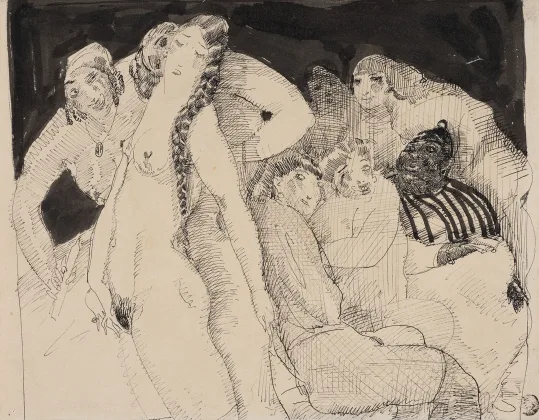
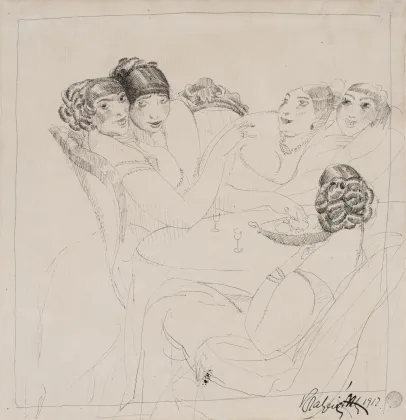
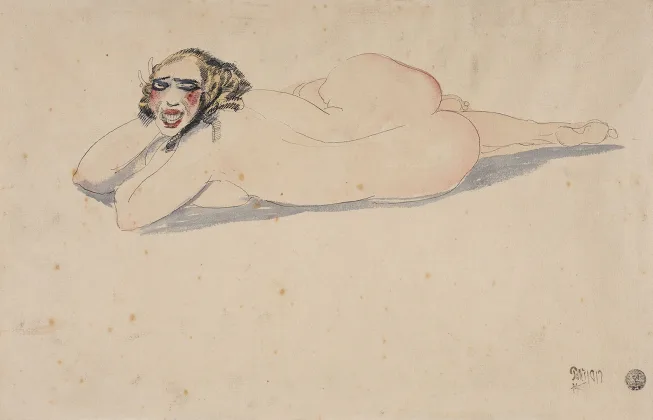
The Parisian interiors in which women live, socialise and talk is the most frequent motif preoccupation of the “chirpy painter and young gentleman” Kraljević who, just like Babić described him, “in the colourful reality of brothels over the murky waters of the modern Babylon, with pleasure and joy seeks the charm of its external ornamentation.” [22] Woman is his great subject matter and obsessive preoccupation. Moving around the café interiors and brothel salons and bedrooms, either as an involved participant or as an unbiased observer, Kraljević reveals women’s secrets, impulses, passions, “painting in female figures all the diabolism and all the bestiality of the lewd sexus,” [23] portraying their faces of different features, memorising the contours of their bodies by drawing them directly or later, by memory, in the stillness of his studio (Women at Table, Erotic Scene, Lying Nude from Behind, Odalisque). Kraljević’s fascination with the female body always coupled with admiration and contempt, as embodies in the drawings through a touch of irony and sardonic sarcasm. The female bodies are deformed to the imperative of ugliness and abjection, as an expression of Kraljević’s moralist view of this demimonde of the Parisian scene and its moral and physical decay. In his drawing chronicles, the brothel women are unsightly, frivolous, unprepossessing, challenging creatures… The Parisian brothel drawings in Kraljević’s playful and poignant drawing paraphrasis and reinterpretation seem to find an obscene thematic background in Rops’s perverted world of harlots, Baudelaire’s licentious poetry of sensual pleasures and spleen, and Toulouse-Lautrec’s chronicle of the erotic and drunken Parisian fin-de-siècle. Writing about Kraljević in 1918 in Savremenik, Artur Schneider points to correlations with Constantin Guys, tracing motif and thematic links between them: “Like Guys, Kraljević also descends to the lowest backlog of the sphere, to the whorehouse, he draws enormous pleasure-inviting sofas, with rolling hypertrophied bulging bodily masses like molluscs, he draws knowing withered and enervated faces, lazy, licentious and lascivious movements and situations… (…) It is also telling that all the characters from this milieu show a peculiar oriental, Semitic physiognomy, which keep reappearing, only slightly varied, in all the sheets. Low brow, broad and narrow, the shadowy eye, the Semitic curved nose, wide faces, plump lecherous lips. This impression is further accentuated by the short, orientally styled thick black hair and, as I mentioned, curvaceous physiques.” [24] The traces of other people’s influences captured in memory, absorbed in the Parisian metropolis – the hub of the rising modernism, were interpreted by Kraljević through a stroke of his own and the vibrant energy of the drawing method. In the drawing Women at Table we identify the common traits with Guys’s drawing Four Women on a Sofa in almost exactly the same posture of side-slanting characters. Similar reinterpretations of stylistic and morphological elements are traceable in Kraljević’s woodcuts Cocottes and Worshipping Beauty, whose compositions are relatable to the stylised fine-lined back and white works by Aubrey Beardsley.
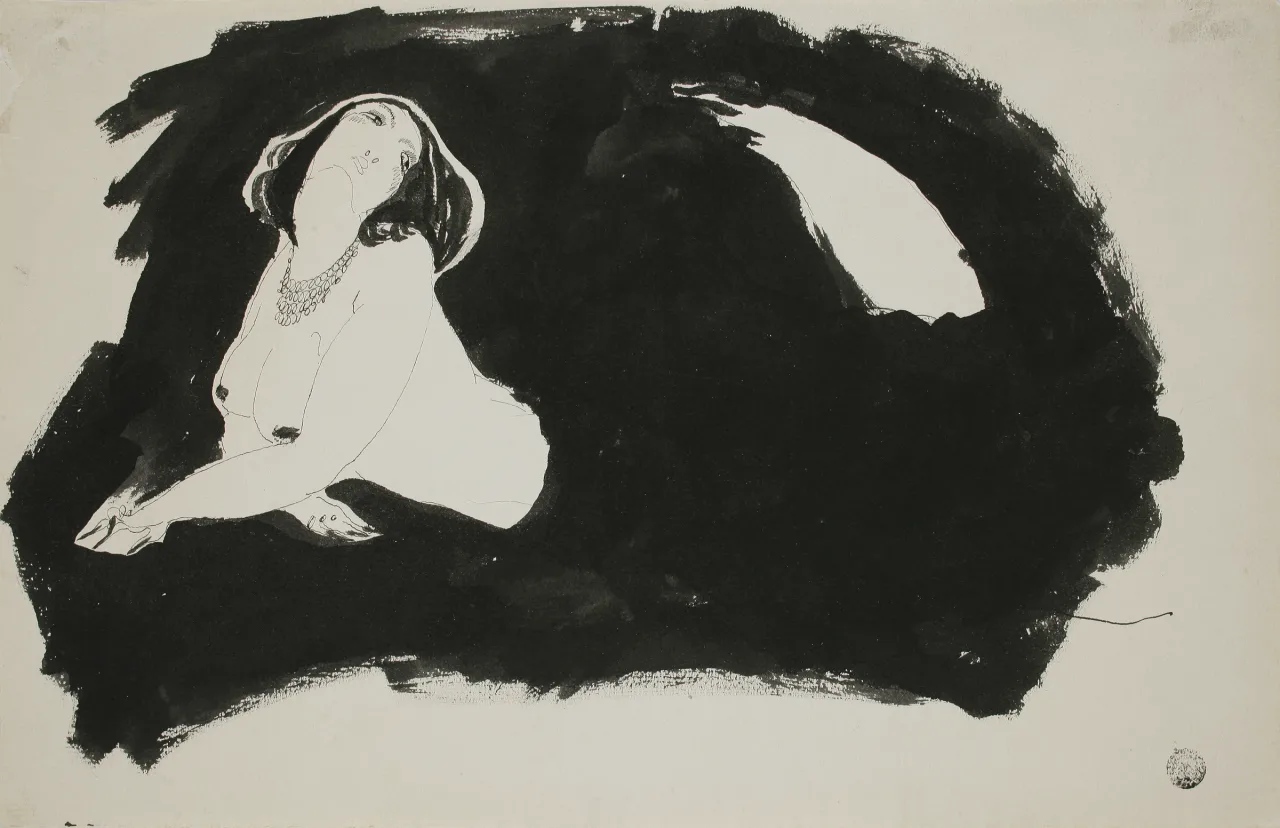
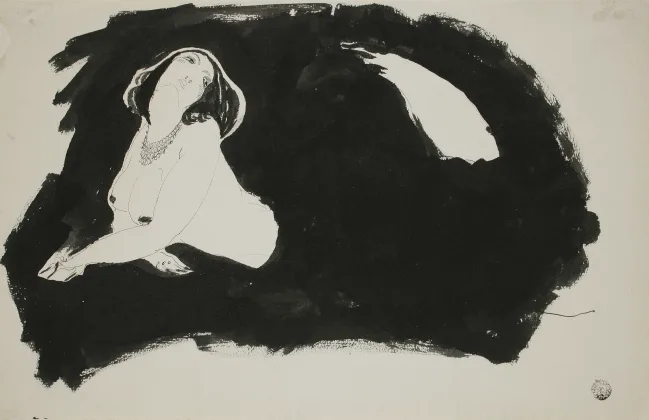
The emblematic drawing Nude in Black is undoubtedly one of the finest in the collection of the Department of Prints and Drawings, rightfully considered an anthological piece of both Croatian and European modernity. [25] Intimate in both its format and subject matter, the drawing is a sublimation of Kraljević’s relationship to women and erotism; its auraticity singles it out among the rich body of Parisian virtuoso drawings – the erotomaniac journal entries from Parisian life. It synthesises Kraljević’s two drawing levels: the confident and descriptive quill stroke and the soft painterly brush gesture. From an interpretational point of view, Nude in Black is anchored in the gap between his erotic works and those immersed in the field of more explicit sexuality, reconciling in the idiomatic expression the two aspects of his complex character: on the one hand emotional and sensual, and on the other dark and perverted. In line with Kraljević’s modernist orientation, an exceptional compositional harmony is struck between the descriptive illustrative approach in drawing a woman’s head and torso, and the abstracted leg shank, whose morphogenesis and achromatism reminds of Vallotton’s versions. The black parts engulfing and negating the woman’s alabaster body locate their anticipatory mainstay in the symbolism of Eros – the ecstatic female nude – and the surging Thanatos cloaked in tuberculotic must. The allusive black implies a lecherous and lewd atmosphere of the darkened spaces of brothel bedrooms, and the seductive position of the female nude is highlighted by the ecstatic position of the woman’s head in the wake of Toulouse-Lautrec’s sensual throwback. The thick and wavy hair surrounding the gentle face and the curvaceous breasts decorated by jewellery are polar opposites to the position of the hands, which are “repulsive, rapacious, fishlike and beak-topped;“ [26] again in a hiatus between Eros and Thanatos. Intimate in format as in topic, the drawing is a sublimation of Kraljević’s relationship to woman and erotism; its auraticity makes it stand out among the rich work of virtuoso Parisian drawings – journal entries from an erotomaniac Parisian life.
In the bohemian, artistically propulsive and avant-garde Paris, Miroslav Kraljević reached the peak of his accomplishments as a painter and the expressionist drawing and graphic expression which was, unfortunately, terminated by his untimely death. Paris as a desired destination opened a new chapter of his creative development under the influence of Édouard Manet and Paul Cézanne’s painting, which he brought back to his home country through his art. Absorbing the vibrant modernist influences of the European art capital, in Paris Kraljević developed a more mature drawing poetics which, shadowed by the imminent death, grew visibly more productive. In the national art historian terminology he remained treasured as the spiritus movens of Croatian modernism and a proclaimed pioneer of Croatian expressionism.
Ružica Pepelko
[1] Together with Josip Račić, Vladimir Becić and Oskar Hermann, Kraljević is a member of the so-called Die kroatische Schule (later known as the Munich circle), under professor Hugo von Habermann, part of the Leibl circle, at the Munich academy. See more in: R. Pepelko, “Crtačke poetike münhenskih đaka početka 20. Stoljeća”, in: Vesna Kedmenec Križić, Ružica Pepelko, Skice i crteži münchenskih đaka iz fundusa Kabineta grafike Hrvatske akademije znanosti i umjetnosti, exhibition catalogue, ed. Slavica Marković, Zagreb: Department of Prints and Drawings, Croatian Academy of Sciences and Arts, 2009, 42-77.
[2] Artur Schneider, Miroslav Kraljević, Zagreb: Savremenik, 1918, 14.
[3] Vera Horvat Pintarić, Miroslav Kraljević, Zagreb: Globus, 1985, 45-46, 61-65.
[4] VHP, ibid., 306-307.
[5] Vlasta Kovač, “Znam, vaši nikad neće dopustiti da se udate za umjetnika…”, in: Vjesnik, 16 July 1972, 8.
[6] To broaden the interpretative and thematic context and to depict the atmosphere and the mood of Paris of the time, we complement it with a quote from the artist’s letter to his uncle Laco, dating from 13 December 1911: “The weather here is quite wonderful, sunny almost every day, warm like in our country in early autumn, and across boulevards people still sit in front of cafes. The Parisians take their spite so far as to, in the street, among the tables, with a large thick carpet underneath, take out a couple of silver-plated coke ovens to warm the surrounding air. Since there are no harsh winters in this city, nothing is adapted to the cold. There are many large shops, which take their goods from the streets inside, you don’t even have to move in – that is how they do trade in winters, in front of the entrance door, beckoning the passers-by and offering them things.”; in: Matko Peić, “Miroslav Kraljević”, in: Hrvatski umjetnici, Zagreb: Biblioteka Gledišta, Znanje, 1968, 211.
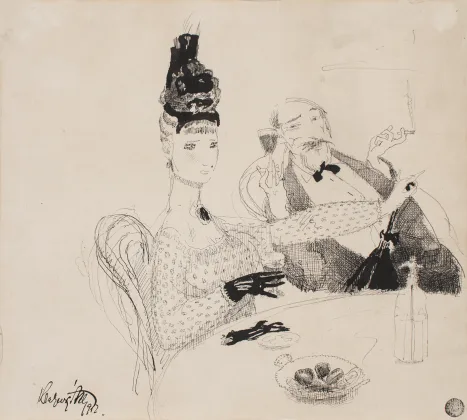
[7] Grgo Gamulin, “Miroslav Kraljević”, in: Hrvatsko slikarstvo na prijelazu iz XIX. u XX. stoljeće, vol. II, Zagreb: Naprijed, 1995, 311.
[8] VHP, ibid., 36-37.
[9] G. M. Sugana, Toulouse-Lautrec, Milano: Rizzoli Editore, 1977, 111; https://www.gettyimages.com/detail/news-photo/yvette-guilbert-french-cabaret-singer-and-actress-1913-news-photo/463969613 (13 May 2026)
[10] Schneider, ibid., 49.
[11] Schneider, ibid., 36.
[12] VHP, ibid., 40, 131 (note 121).
[13] Honore de Balzac, Propale iluzije, Zagreb: Kultura, 1952, 688-689.
[14] https://www.britannica.com/art/ballet/The-era-of-the-Ballets-Russes (14 May 2026)
[15] https://www.vam.ac.uk/articles/diaghilev-and-the-ballets-russes (14 May 2026); VHP, ibid., 41-43, 49, 128 (note 60, 61), 129. (note 63, 64).
[16] VHP, ibid., 49, 53, 129 (note 61).
[17] Kraljević described his most powerful impressions of Paris in the following words: “You will say I am exaggerating – I am convinced and I can comprehend well, for I have experienced and sensed – even if I wrote fifteen sheets of paper and used my finest style and best descriptive manners, I still would not be able to depict the impression one inevitably gets when, say, he enters around midnight in Café Olympia. One gets the impression that a god must have dropped a bagful of the finest and most magnificent gems and pearls which he had gathered not in this world, but rather somewhere beyond the clouds. These pearls became lovely little women, very few of them are not capable of giving you the so-called ‘heartbeat’ with one just casual glance.” Schneider, ibid., 28, 30.
[18] Schneider, ibid., 32.
[19] Kraljević wrote about the drinking culture in a letter to his uncle Teodor from Paris, dated 6 February 1912: “There is a lot if drinking around here, but again not that terribly, and it is famous only because no other nation drinks it (absinthe) at all, meaning it is imposed to the French people. They drink wine around here, just like in Požega, by the litre, from small wine glasses.” VHP, ibid., 296.
[20] VHP, ibid., 48.
[21] VHP, ibid., 69, 129 (note 74).
[22] Ljubo Babić, „Umjetnost kod Hrvata“, in: Sabrana djela Ljube Babića, vol. I, Zagreb: Naklada A. Velzek, 1943, 170.
[23] Antun Gustav Matoš, Kristali duha: Misli i pogledi A. G. Matoša, eds. Mate Ujević and Dubravko Jelčić, Zagreb: Školska knjiga, 1994, 267.
[24] Schneider, ibid., 36-37, 48.
[25] VHP, ibid., 17.
[26] VHP, ibid., 69.